


How Surgical Wisdom Tooth Extraction Was Performed
Wisdom teeth do not always have enough space to grow into a healthy position. When a wisdom tooth remains trapped beneath the gum or develops at an unsuitable angle, it may become difficult to clean and can affect the surrounding teeth and tissues.
In this case, a detailed clinical examination and dental X-rays identified a wisdom tooth that required surgical extraction. A personalised treatment plan was prepared to remove the tooth carefully while protecting the surrounding structures.
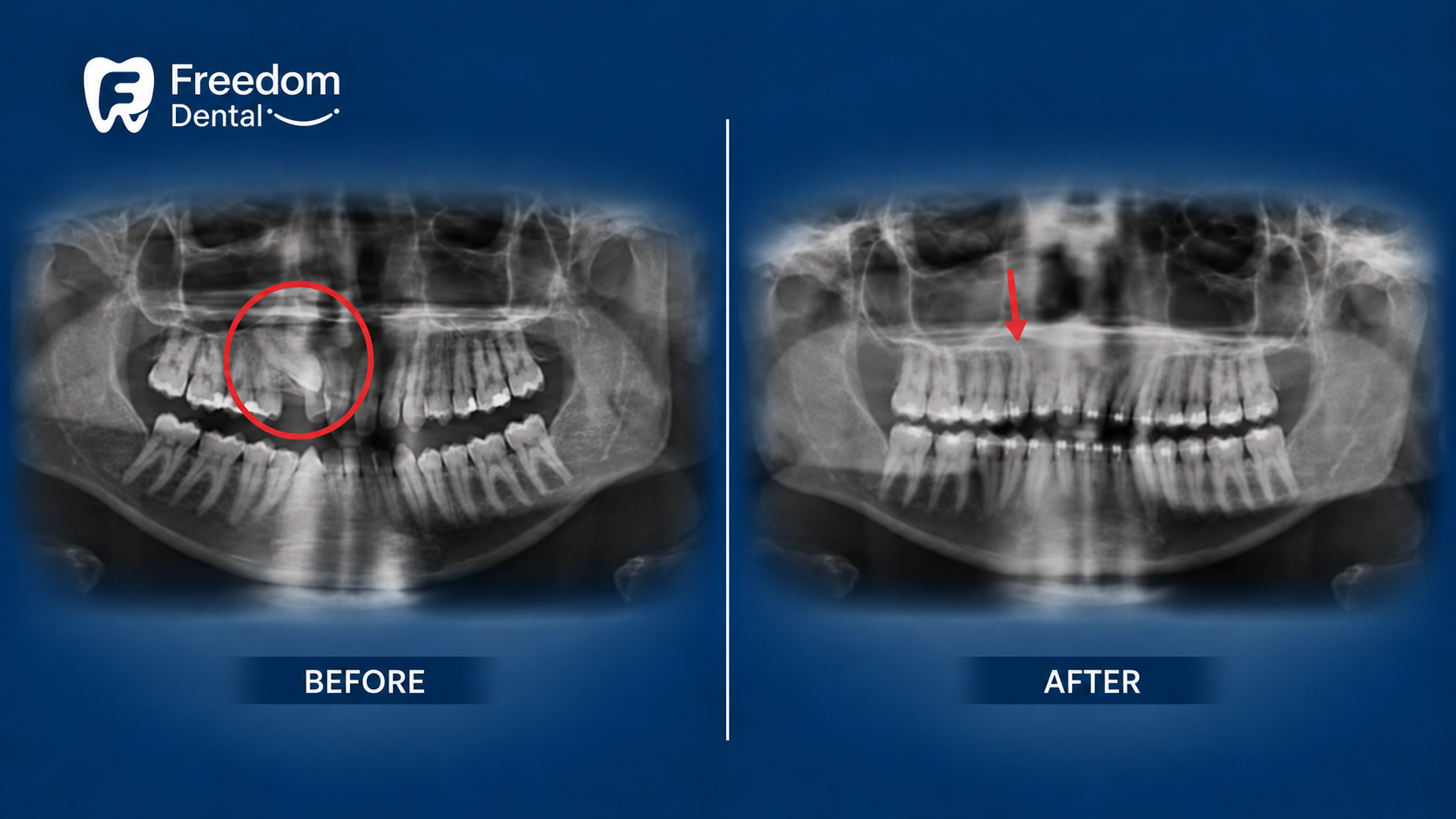
The before-and-after panoramic X-rays document the area prior to treatment and following the completed surgical extraction.
The Patient’s Initial Condition
The initial panoramic X-ray showed a tooth that had not erupted into a normal functional position. Its location and limited accessibility meant that a straightforward extraction was not considered the most appropriate approach.
Impacted or poorly positioned wisdom teeth may be associated with:
Repeated pain or tenderness.
Swelling around the affected area.
Food becoming trapped behind nearby teeth.
Difficulty cleaning the area properly.
Gum inflammation or infection.
Decay affecting the wisdom tooth or a neighbouring tooth.
Pressure on surrounding dental structures.
Not every impacted wisdom tooth needs to be removed. The decision depends on its position, symptoms, surrounding structures and the patient’s wider oral health.
Assessment and Treatment Planning
Before treatment, the Freedom Dental team reviewed the patient’s panoramic X-ray to assess the tooth’s position, angle and relationship with the surrounding teeth and bone.
The assessment also included a discussion of the patient’s symptoms, medical history and available treatment options. Because the tooth required additional access for safe removal, a surgical extraction was recommended.
The planned procedure, anaesthetic, expected recovery and aftercare instructions were explained before treatment began.
The Surgical Wisdom Tooth Extraction
The treatment was completed using an appropriate surgical approach based on the tooth’s position.
The procedure involved:
Administering local anaesthetic to numb the treatment area.
Carefully accessing the impacted tooth.
Creating sufficient space for controlled removal.
Dividing the tooth into smaller sections where clinically required.
Removing the tooth and checking the extraction site.
Cleaning the area thoroughly.
Closing the surgical site where necessary.
Providing detailed recovery and aftercare instructions.
The exact procedure used for a surgical wisdom tooth extraction varies according to the tooth’s angle, root formation, depth and relationship with nearby anatomical structures.
Surgical Wisdom Tooth Extraction Before and After Results
The after-treatment X-ray shows the area following removal of the problematic tooth. The extraction was planned to resolve the dental concern while protecting the neighbouring teeth and surrounding structures.
Following the procedure, the patient received personalised advice on managing the early healing period. A follow-up appointment may be recommended to monitor recovery and check the extraction site.
What Is the Difference Between Simple and Surgical Extraction?
A simple extraction is generally possible when a tooth is fully visible and can be removed using standard dental instruments.
A surgical extraction may be necessary when the tooth:
Is impacted beneath the gum or bone.
Has not fully erupted.
Is positioned at a difficult angle.
Has complex or curved roots.
Is difficult to access.
Is close to important anatomical structures.
Needs to be divided into sections for controlled removal.
The appropriate approach can only be determined after a clinical examination and review of the necessary dental imaging.
Recovery After Wisdom Tooth Surgery
Some swelling, tenderness, bruising or mild bleeding can occur during the initial recovery period. These effects should generally improve as the extraction site heals.
Patients may be advised to:
Keep the provided gauze in place for the recommended period.
Avoid vigorous rinsing during the first day.
Choose soft foods while the area remains tender.
Avoid smoking during the initial healing period.
Keep the mouth clean according to the dentist’s instructions.
Avoid strenuous physical activity when advised.
Take prescribed or recommended medication as directed.
Avoid disturbing the extraction site with the tongue or fingers.
Recovery time varies according to the complexity of the procedure, the position of the tooth and the patient’s general health.
When Should You Contact the Dentist?
Contact the dental clinic if you experience:
Bleeding that does not settle.
Severe or increasing pain.
Swelling that continues to worsen.
Fever or feeling generally unwell.
Persistent discharge or an unpleasant taste.
Numbness that does not improve as expected.
Difficulty swallowing or breathing.
Severe swelling or difficulty breathing requires urgent medical attention.
Surgical Wisdom Tooth Extraction at Freedom Dental
Freedom Dental provides assessment and treatment for impacted wisdom teeth, complex tooth extractions and other oral surgery concerns in Dublin.
Every treatment begins with an individual assessment to understand the tooth’s position, the condition of the surrounding structures and whether extraction is clinically appropriate.
Learn more about Oral Surgery and Complex Extractions at Freedom Dental.
Book a Wisdom Tooth Assessment in Dublin
If you have pain, swelling or repeated problems around a wisdom tooth, book an assessment to identify the cause and discuss the available options.
Book an appointment at Freedom Dental
You can also call:
085 830 0289
01 872 95 69