

Braces vs Invisalign Which Treatment Should You Choose?
If you want straighter teeth, you may be comparing braces vs Invisalign and wondering which treatment is better for your smile.
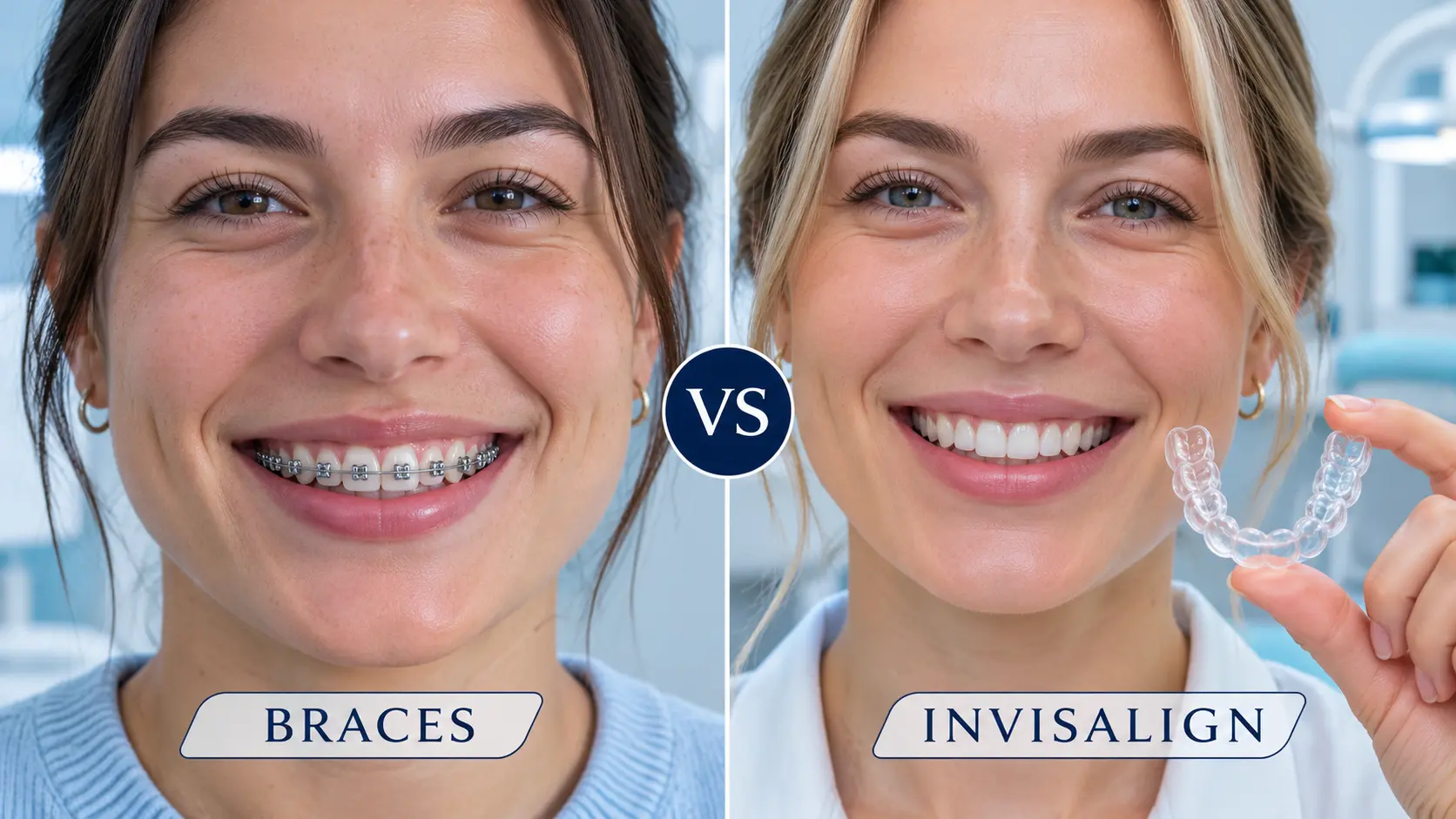
Both treatments gradually move teeth into planned positions, but they work differently. Traditional braces use fixed brackets and wires, while Invisalign uses a series of removable clear aligners created for your teeth.
The right choice depends on the position of your teeth, your bite, treatment complexity, lifestyle and ability to follow the treatment instructions. At Freedom Dental, treatment begins with an assessment so the dentist can explain which options may be suitable for your individual case.
Braces vs Invisalign at a Glance
Factor | Dental braces | Invisalign |
|---|---|---|
Appliance | Fixed brackets and wires | Removable clear aligners |
Appearance | Metal or tooth-coloured brackets are visible | Clear and less noticeable |
Removal | Cannot be removed by the patient | Removed for eating and cleaning |
Compliance | Works continuously once fitted | Requires consistent daily wear |
Food | Some hard and sticky foods should be avoided | Aligners are removed before eating |
Cleaning | Extra cleaning around brackets is required | Teeth can be brushed normally after removing aligners |
Treatment planning | Adjusted through wires and brackets | Uses a sequence of custom-made aligners |
Suitable cases | Can treat a broad range of movements | Depends on the type and complexity of movement |
Retainers | Required after treatment | Required after treatment |
Cost | Depends on appliance and complexity | Depends on complexity and number of aligners |
This comparison provides a general overview. An orthodontic assessment is required before deciding which option is appropriate.
How Do Traditional Braces Work?
Dental braces use brackets attached to the teeth and connected by an orthodontic wire. The system applies controlled pressure to move the teeth gradually.
During treatment, the dental team reviews your progress and makes adjustments when required.
Braces may be used to improve:
Crooked teeth.
Crowded teeth.
Gaps between teeth.
Uneven tooth positions.
Certain overbite concerns.
Certain underbite concerns.
Some crossbite problems.
Selected bite and chewing concerns.
Because braces are fixed, they continue working throughout the day without relying on the patient to remember to put them back in.
HSE guidance explains that fixed braces are made from metal or clear ceramic brackets connected by wires. Treatment commonly lasts between six months and two years, depending on the movements required. www2.hse.ie
Learn more about dental braces at Freedom Dental.
How Does Invisalign Work?
Invisalign treatment uses a sequence of clear, custom-made aligners. Each set applies controlled pressure to move selected teeth towards their planned positions.
The aligners are replaced according to the treatment schedule provided by your dentist. Regular progress appointments are required to check that the teeth are moving as planned and that each aligner fits correctly.
Invisalign aligners are:
Clear.
Removable.
Custom-made.
Worn throughout most of the day.
Removed for eating and oral hygiene.
Changed according to a planned sequence.
Patients are generally instructed to wear Invisalign aligners for approximately 20 to 22 hours each day. Failing to wear them consistently may delay treatment or affect the planned result. Invisalign clear aligners
Learn more about Invisalign treatment at Freedom Dental.
Which Treatment Is More Discreet?
Invisalign is usually the more discreet option because the aligners are clear and fit closely over the teeth.
They may suit patients who want their orthodontic appliance to be less noticeable during:
Work.
Meetings.
Social occasions.
Photographs.
Weddings and events.
Public-facing roles.
However, Invisalign treatment may still involve small tooth-coloured attachments placed on selected teeth. These help the aligners apply the movements included in your treatment plan.
Clear braces are another option for patients who want fixed treatment with less noticeable brackets. They use tooth-coloured or transparent brackets but still require an orthodontic wire.
Which Is Better for Complex Tooth Movement?
Fixed braces can provide controlled movement across a broad range of orthodontic cases. They may be recommended when the dentist needs precise control over multiple teeth or when the treatment is more complex.
Invisalign can treat many alignment and bite concerns, but suitability depends on:
The type of movement required.
The severity of crowding or spacing.
The position of the teeth.
Your bite.
Whether additional procedures are needed.
Your ability to wear the aligners consistently.
A more complex case does not automatically mean that Invisalign is impossible. However, the final decision should be based on a clinical assessment rather than appearance alone.
Braces vs Invisalign for Crowded Teeth
Both braces and Invisalign may be used to improve crowded teeth.
The appropriate treatment depends on how much space is available and the degree of movement required. Treatment may involve:
Expanding available space.
Repositioning rotated teeth.
Moving teeth backwards or forwards.
Reducing small amounts of enamel between selected teeth.
Considering extraction in certain cases.
No single approach is appropriate for every patient. Your dentist will assess the crowding and explain how space may be created safely.
You can view an example in our crowded teeth orthodontic treatment case study.
Braces vs Invisalign for Gaps
Braces and Invisalign may both help close gaps between teeth.
The cause of the spacing should be assessed first because gaps can be related to:
Tooth size.
Missing teeth.
Tooth position.
Gum health.
The shape of the dental arch.
Oral habits.
The tissue between the front teeth.
Closing a gap without understanding its cause may not provide a stable long-term result. Your treatment plan should also explain how the new tooth positions will be maintained after active treatment.
Which Treatment Is Easier for Eating?
Invisalign generally creates fewer food restrictions because the aligners are removed before eating.
You should not eat while wearing Invisalign aligners. After eating, clean your teeth before placing the aligners back in your mouth.
With fixed braces, certain foods can damage the brackets or wires. You may be advised to avoid or limit:
Hard sweets.
Ice.
Sticky foods.
Chewing gum.
Very hard or crunchy foods.
Biting directly into hard fruit.
Chewing pens or fingernails.
Harder foods can often be cut into smaller pieces rather than bitten directly.
Which Is Easier to Clean?
Invisalign aligners are removable, so you can brush and floss without fixed brackets blocking access to the tooth surfaces.
However, you must also clean the aligners and avoid putting them back over teeth that have not been cleaned after eating.
Braces require more detailed cleaning because food and plaque can collect around:
Brackets.
Wires.
The gumline.
Areas between the teeth.
You may need an interdental brush, orthodontic toothbrush or other cleaning tools recommended by your dental team.
HSE guidance notes that braces can trap food and allow additional plaque to collect, making careful cleaning and continued dental reviews important during treatment. www2.hse.ie
Read our guide to looking after dental braces for practical cleaning advice.
Which Option Requires More Discipline?
Braces are fixed to the teeth and cannot be removed by the patient. Once fitted, they continue applying pressure without you needing to remember to wear them.
Invisalign requires greater daily responsibility. You need to:
Wear the aligners for the prescribed number of hours.
Remove them before eating.
Clean your teeth before replacing them.
Keep the aligners clean.
Change each set according to the schedule.
Store them safely when removed.
Attend progress appointments.
If you frequently forget to wear removable appliances, braces may be the more predictable option.
If you can follow the schedule closely, Invisalign can provide a discreet and flexible treatment experience.
Is Invisalign More Comfortable Than Braces?
Both treatments apply pressure to move teeth, so some discomfort can occur.
With braces, patients may experience:
Tenderness after fitting.
Pressure after adjustments.
Brackets rubbing the cheeks or lips.
Irritation from a loose or broken wire.
With Invisalign, patients may experience:
Tightness when starting a new aligner.
Mild tooth tenderness.
Temporary irritation along an aligner edge.
Pressure from attachments.
Invisalign does not have metal brackets or wires, which can reduce certain forms of soft-tissue irritation. However, it should not be described as completely pain-free.
Contact Freedom Dental if discomfort is severe, persistent or associated with a broken appliance.
Can You Remove Invisalign for Special Occasions?
Invisalign can be removed temporarily for eating, drinking, brushing, flossing and selected special occasions.
However, removing the aligners too often or leaving them out for long periods can affect progress. The convenience of a removable appliance must be balanced with the need for consistent daily wear.
Braces cannot be removed for photographs, meetings or events. If appearance is a major concern, clear brackets or Invisalign may be discussed during your consultation.
How Long Does Each Treatment Take?
Treatment time depends on:
Your starting tooth positions.
The complexity of your bite.
The amount of movement required.
The treatment method.
Your biological response.
Appointment attendance.
Appliance damage.
Invisalign wear time.
Oral hygiene and gum health.
Braces commonly take between six months and two years, although complex treatment may take longer. Invisalign treatment duration also varies and should be confirmed after the digital assessment and treatment planning stage.
Do not choose a treatment only because it appears to promise a faster result. A shorter plan is useful only if it can safely achieve the required tooth and bite movements.
How Much Do Braces and Invisalign Cost?
The cost of either treatment depends on the complexity of the case, treatment duration, number of appointments and the type of appliance selected.
Dental braces at Freedom Dental start from:
From €750
The final braces cost may depend on:
Metal or clear brackets.
Treatment complexity.
Number of arches treated.
Treatment duration.
Required appointments.
Whether retainers are included.
Any dental treatment needed beforehand.
Invisalign pricing is provided after an assessment because the number of aligners and level of treatment differ between patients.
A lower advertised figure should not be the only factor in your decision. Ask what the quote includes, particularly:
The assessment.
Scans or records.
The orthodontic appliance.
Progress appointments.
Emergency appointments.
Refinement aligners.
Removal of braces.
Retainers.
Retainer reviews.
Private orthodontic costs in Ireland vary according to the teeth being moved and treatment complexity. HSE guidance also states that eligible private orthodontic treatment may qualify for tax relief through the Med 2 scheme. www2.hse.ie
Are Braces or Invisalign Better for Teenagers?
Either treatment may be appropriate for teenagers, depending on their dental development and ability to follow instructions.
Braces may be preferable when:
The teenager may forget to wear aligners.
The movements are more complex.
A fixed appliance provides more reliable control.
There is a high risk of losing removable aligners.
Invisalign may be considered when:
The case is suitable for clear aligners.
The teenager can follow the wear schedule.
Appearance is an important concern.
The aligners can be cleaned and stored responsibly.
A parent or guardian may need to help monitor wear, cleaning and appointment attendance.
Are Braces or Invisalign Better for Adults?
Many adults can be treated with braces or Invisalign, provided their teeth, gums and supporting bone are healthy enough for orthodontic movement.
Invisalign is often appealing to adults because it is discreet and removable. Braces may be recommended when a fixed appliance offers greater control for the planned movement.
Adult treatment may also require additional planning if you have:
Crowns.
Bridges.
Dental implants.
Missing teeth.
Previous root canal treatment.
Gum recession.
Bone loss.
Teeth that moved after previous braces.
Age alone does not determine which treatment is suitable.
Can You Switch from Braces to Invisalign?
Switching may be possible in selected cases, but it is not a routine option for every patient.
The dentist would need to assess:
Progress already achieved.
Remaining tooth movements.
Your bite.
Treatment records.
The reason for changing.
Additional time and cost.
Your ability to comply with aligner wear.
Changing appliances partway through treatment may increase cost and treatment time, so the initial decision should be considered carefully.
Will You Need Retainers?
Yes. Retainers are usually required after braces and Invisalign.
Teeth can naturally move after active orthodontic treatment. Retainers help hold them in their new positions while the surrounding tissues adapt.
Your retention plan may involve:
A removable clear retainer.
A fixed wire behind the front teeth.
A combination of fixed and removable retainers.
Full-time wear initially.
Night-time wear later.
Long-term retainer use.
Invisalign’s official guidance and the HSE both state that retainers are needed after orthodontic treatment to help prevent teeth from moving back. www2.hse.ie
Real Braces and Invisalign Results at Freedom Dental
Before choosing between the two treatments, you can view genuine patient examples from Freedom Dental.
Crowded Teeth Treated with Orthodontics
Our crowded teeth orthodontic case study demonstrates how controlled orthodontic movement improved tooth alignment and the patient’s smile.
Invisalign Smile Transformation
Our Invisalign Ireland before-and-after case study shows an example of clear aligner treatment used to improve tooth positions while maintaining the natural shape of the patient’s teeth.
These examples demonstrate possible treatment outcomes but cannot guarantee that another patient will achieve an identical result.
Braces vs Invisalign Which Is Better?
Neither option is automatically better for every patient.
Braces may be more suitable if:
Your tooth movements are complex.
You prefer a fixed appliance.
You may forget to wear removable aligners.
You do not mind visible brackets.
Your dentist recommends greater fixed-appliance control.
Invisalign may be more suitable if:
Your case is appropriate for clear aligners.
You want a discreet treatment.
You can wear the aligners consistently.
You want to remove the appliance for meals.
You prefer easier access for brushing and flossing.
The best treatment is the one that can safely achieve your planned result and that you can manage consistently throughout the treatment period.
Book an Orthodontic Consultation at Freedom Dental
At Freedom Dental, your consultation includes an assessment of your teeth, gums, bite and smile goals.
The dentist can explain:
Whether braces or Invisalign may be suitable.
The expected treatment stages.
Approximate treatment duration.
The available appliance options.
The likely cost.
Appointment requirements.
Retainer planning.
Book an orthodontic consultation to compare your options and receive an individual treatment plan.